 Unesco Chair in World #Food Systems
Household food security is an important measure of well-being. Although it may not encapsulate all dimensions of poverty, the inability of households to obtain access to enough food for an active, healthy life is surely an important component of their poverty. Accordingly, devising an appropriate measure of food security outcomes is useful in order to identify the food insecure, assess the severity of their food shortfall, characterize the nature of their insecurity (for example, seasonal versus chronic), predict who is most at risk of future hunger, monitor changes in circumstances, and assess the impact of interventions. However, obtaining detailed data on food security status—such as 24- hour recall data on caloric intakes—can be time consuming and expensive and require a high level of technical skill both in data collection and analysis. This paper examines whether an alternative indicator, dietary diversity, defined as the number of unique foods consumed over a given period of time, provides information on household food security. It draws on data from 10 countries (India, the Philippines, Mozambique, Mexico, Bangladesh, Egypt, Mali, Malawi, Ghana, and Kenya) that encompass both poor and middle-income countries, rural and urban sectors, data collected in different seasons, and data on calories acquisition obtained using two different methods. ....[D]ietary diversity would appear to show promise as a means of measuring food security and monitoring changes and impact, particularly when resources available for such measurement are scarce.
Home > Keywords > Source > Ressources hors Chaire
Ressources hors Chaire
Articles
-
 Dietary diversity as a household food security indicator
3 novembre 2021, par Mathilde COUDRAY -
 Quand l’alimentation se fait Politique(s)
17 février 2020, par Mathilde COUDRAYQui gouverne le système alimentaire et influence les décisions publiques ? Qui innove et expérimente d’autres systèmes alimentaires ? ...
-
 Resource over-exploitation and running out
3 novembre 2021, par Mathilde COUDRAYFood systems around the world are highly dependent on both renewable and nonrenewable resources. Drivers such as population growth, urbanisation and climate change put a lot of pressure on resources that have become core issues for the future of food systems. Cropland availability is limited in most parts of the world, adding pressure for cropping intensification. Fossil energy and phosphorus shortages are expected to occur within a few decades, with particular impact in Low-Income (LI) countries where farmers are more vulnerable to volatile prices. The availability of very unevenly distributed freshwater resources shows a similar picture, with an increasing number of regions reaching alarming levels of water scarcity. Some world fish stocks have been overexploited and are now depleted. But the situation is not without hope. While we need to intensify food systems to meet the challenge of a growing population, new ways to produce with less impact on the environment and more resilience to climate change need to be widely adopted.
-
 A conceptual model of the food and nutrition system
27 octobre 2021, par Mathilde COUDRAYThe integrated model developed here included three subsystems (producer, consumer, nutrition) and nine stages (production, processing, distribution, acquisition, preparation, consumption, digestion, transport, metabolism). The integrated model considers the processes and transformations that occur within the system and relationships between the system and other systems in the biophysical and social environments. The integrated conceptual model of the food and nutrition system presents food and nutrition activities as part of a larger context and identifies linkages among the many disciplines that deal with the food and nutrition system.
-
 Étude de démarches de durabilité dans le domaine alimentaire
23 novembre 2021, par Mathilde COUDRAYBasée sur un travail de revue de littérature, cette étude prend en compte les cahiers des charges qui influent plus ou moins fortement sur les modes de production, et regarde également les actions annexes au cahier des charges. Nous avons interrogé les acteurs des démarches pour comprendre leurs intentions, puis analysé les chaînes de production afin d’évaluer les effets réels des démarches. L’étude permet donc de comparer les intentions affichées avec les garanties réellement offertes par le label.
-
 Food systems at risk
26 octobre 2021, par Mathilde COUDRAYThe way food systems have evolved over past decades means that they now face major risks, which in turn threaten the future of food systems themselves. Food systems have seriously contributed to climate change, environmental destruction, overexploitation of natural resources and pollution of air, water and soils. Despite the global average improvement in calorie production and major development of the food and agricultural product markets, huge inequalities in food access and repartition of the added value have emerged, leading to new serious nutritional and social problems. Based on a review of the most recent scientific knowledge, this report emphasizes Low-Income and Lower Middle-Income countries where the population faces greater challenges than elsewhere. Different threats are adding up and there are few options to adapt or mitigate these combinations of risks. This is a call for all those - businesses, policy makers, consumers, funding agencies - who are engaged in food systems transformations to bear in mind their systemic aspects and their multiple outcomes and risks in order to be able to fashion more sustainable and equitable food systems.
This report was prepared and coordinated by the Centre de coopération internationale en recherche agronomique pour le développement (CIRAD), and is a joint production with the Food and Agriculture Organization of the United Nations (FAO) and the European Commission’s Directorate-General for International Cooperation and Development (DG DEVCO). The scientific report hereunder takes stock of the current and future risks and challenges as regards to food systems.
-
 La transition en actions. Des initiatives inspirantes pour une agriculture et une alimentation plus durables
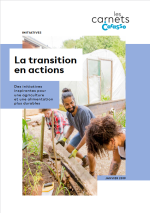
23 novembre 2021, par Mathilde COUDRAYCe document sur la Transition en actions présente des initiatives pour inspirer ceux qui souhaitent accélérer la transition sur leurs territoires. Les solutions présentées dans cet ouvrage sont des illustrations concrètes de démarches déjà mises en œuvre en France et en Espagne qui sont soutenus par la Fondation Daniel et Nina Carasso.
-
 Food swamps predict obesity rates better than food deserts in the United States
3 novembre 2021, par Mathilde COUDRAYThis paper investigates the effect of food environments, characterized as food swamps, on adult obesity rates. Food swamps have been described as areas with a high-density of establishments selling high-calorie fast food and junk food, relative to healthier food options. This study examines multiple ways of categorizing food environments as food swamps and food deserts, including alternate versions of the Retail Food Environment Index. We merged food outlet, sociodemographic and obesity data from the United States Department of Agriculture (USDA) Food Environment Atlas, the American Community Survey, and a commercial street reference dataset. We employed an instrumental variables (IV) strategy to correct for the endogeneity of food environments (i.e., that individuals self-select into neighborhoods and may consider food availability in their decision). Our results suggest that the presence of a food swamp is a stronger predictor of obesity rates than the absence of full-service grocery stores. We found, even after controlling for food desert effects, food swamps have a positive, statistically significant effect on adult obesity rates. All three food swamp measures indicated the same positive association, but reflected different magnitudes of the food swamp effect on rates of adult obesity (p values ranged from 0.00 to 0.16). Our adjustment for reverse causality, using an IV approach, revealed a stronger effect of food swamps than would have been obtained by naïve ordinary least squares (OLS) estimates. The food swamp effect was stronger in counties with greater income inequality (p < 0.05) and where residents are less mobile (p < 0.01). Based on these findings, local government policies such as zoning laws simultaneously restricting access to unhealthy food outlets and incentivizing healthy food retailers to locate in underserved neighborhoods warrant consideration as strategies to increase health equity.
-
 The new science of sustainable food systems : overcoming barriers to food systems reform
27 octobre 2021, par Mathilde COUDRAYTo accelerate the shift towards sustainable food systems, a new science of sustainable food systems is needed. This paper traces out the contours of a new analytical framework for sustainable food systems (Section 1). It then describes the principles of transdisciplinary science that must be applied in order to generate the types of knowledge that can support the transition to sustainable food systems (Section 2). Finally, it considers previous and ongoing attempts to address sustainable food systems at the interface of science, policy and practice, in order to identify where initiatives have succeeded, where challenges remain, and how these energies can be harnessed and combined to support the transition to sustainable food systems (Section 3).
-
 L’alimentation au cœur des sociabilités ville-campagne. L’exemple des marchés fermiers comme formes d’interactions entre populations agricoles et touristiques
26 octobre 2021, par Mathilde COUDRAYL’expérience alimentaire associée au tourisme semble être le lieu de multiples aspirations et représentations, notamment en espace rural, donnant lieu à de nouvelles pratiques, offres et filières situées parfois en marge d’un développement touristique plus institutionnalisé. C’est le cas de l’agritourisme, défini comme l’ensemble des activités touristiques pratiquées sur une exploitation agricole et présenté comme moyen de diversification aux bénéfices multiples. Considérant le décalage entre perceptions du monde agricole et réalité du terrain, l’agritourisme, à travers la valorisation de produits agricoles et alimentaires, est analysé comme un moyen de renouer le dialogue et de tisser des liens entre population agricole et société civile. En encourageant un public de non-initiés à réfléchir et à penser l’agriculture, en valorisant des images et des pratiques spécifiques, mais aussi en partageant des valeurs et des visions contrastées du monde agricole et rural, les agriculteurs, à travers la valorisation de leurs produits agricoles et alimentaires, sont au cœur de processus d’interactions. Cette contribution vise ainsi, avec l’exemple des marchés fermiers, à questionner l’alimentation comme vecteur de nouvelles formes de sociabilités entre ville et campagne. L’analyse se base sur une étude exploratoire conduite en 2015 dans la région Midi-Pyrénées (France) auprès d’agriculteurs et d’agricultrices proposant des marchés sur leur exploitation agricole.