 Unesco Chair in World #Food Systems
Les animaux continuent de jouer un rôle majeur dans les systèmes de production alimentaire du monde entier. L’élevage compte parmi les moyens de subsistance de 1,7 milliard de petits exploitants agricoles dans le Sud et joue un rôle économique crucial pour environ 60 % des ménages ruraux dans les pays en développement. Le secteur emploie également jusqu’à 4 millions de personnes dans l’UE, où 58 % des exploitations agricoles, dont de nombreuses petites et moyennes exploitations, comprennent des animaux. Parallèlement, la pêche et l’aquaculture font vivre près de 60 millions de personnes dans le monde, et plus de 3 milliards dépendent du poisson comme principale source de protéines. Cependant, nombreux sont ceux dont le régime alimentaire reste principalement basé sur les légumineuses, les céréales et d’autres aliments d’origine végétale, avec une consommation minimale d’aliments d’origine animale.
Home > Keywords > Source > Ressources hors Chaire
Ressources hors Chaire
Articles
-
 La politique des protéines - IPES FOOD
25 mai 2022, par Mathilde COUDRAY -
 Avoiding the local trap : scale and food systems in planning research
3 novembre 2021, par Mathilde COUDRAYA strong current of food-systems research holds that local food systems are preferable to systems at larger scales. Many assume that eating local food is more ecologically sustainable and socially just. We term this the local trap and argue strongly against it. We draw on current scale theory in political and economic geography to argue that local food systems are no more likely to be sustainable or just than systems at other scales. The theory argues that scale is socially produced : scales (and their interrelations) are not independent entities with inherent qualities but strategies pursued by social actors with a particular agenda. It is the content of that agenda, not the scales themselves, that produces outcomes such as sustainability or justice. As planners move increasingly into food-systems research, we argue it is critical to avoid the local trap. The article’s theoretical approach to scale offers one way to do so.
-
 Limited food availability
3 novembre 2021, par Mathilde COUDRAYWhile food security is a major worldwide issue, it is a much more serious problem in Low-Income
(LI) and Lower Middle-Income (LMI) countries. Currently, sub-Saharan Africa is the sub-continent with the highest proportion of undernourished people, the largest gap between current and potential yields, and between cereal consumption and production. Looking to the future, population growth and climate change may worsen the situation, particularly in Africa. African countries are still facing rapid population growth with uncertain prospects about the ability of their agriculture to meet growing food demand. In addition, without sufficient adaptation measures, climate change will negatively impact food production in most African regions. -
 Les Alimentations particulières. Mangerons-nous encore ensemble demain ?
26 octobre 2021, par Mathilde COUDRAYDans la plupart des sociétés humaines et dans la nôtre en particulier, refuser un aliment offert revient à refuser la relation, à s’extraire du cercle des convives et du groupe, signifie la méfiance et appelle l’exclusion. Or, dans le monde contemporain, il semble que des individus de plus en plus nombreux revendiquent une alimentation particulière pour des raisons diverses : médicales (allergies et intolérances), sanitaires (régimes divers), éthiques, politiques ou spirituelles (végétarismes, prescriptions ou proscriptions religieuses).
Cette revendication soudain affirmée ne signale-t-elle pas une évolution, voire une remise en cause, au nom de l’individu, de ce qui pouvait passer pour un fondement de la socialité : le partage et la commensalité ?
La question des alimentations particulières est abordée ici dans une perspective radicalement interdisciplinaire : du biomédical (immunologie, allergies, intolérances) au social et au culturel. La question qui est posée par les alimentations particulières, c’est celle de l’étendue et des limites de l’individualisation dans les sociétés contemporaines.
Renoncerons-nous à toute forme de commensalité ou saurons-nous inventer de nouvelles configurations, suffisamment souples mais suffisamment ritualisées pour donner un sens convivial à l’expérience de la table commune ? (présentation de l’éditeur) -
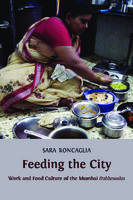 Feeding the city : work and food culture of the Mumbai dabbawalas
26 octobre 2021, par Mathilde COUDRAYEvery day in Mumbai 5,000 dabbawalas (literally translated as "those who carry boxes") distribute a staggering 200,000 home-cooked lunchboxes to the city’s workers and students. Giving employment and status to thousands of largely illiterate villagers from Mumbai’s hinterland, this co-operative has been in operation since the late nineteenth century. It provides one of the most efficient delivery networks in the world : only one lunch in six million goes astray. Feeding the City is an ethnographic study of the fascinating inner workings of Mumbai’s dabbawalas. Cultural anthropologist Sara Roncaglia explains how they cater to the various dietary requirements of a diverse and increasingly global city, where the preparation and consumption of food is pervaded with religious and cultural significance. Developing the idea of "gastrosemantics" – a language with which to discuss the broader implications of cooking and eating – Roncaglia’s study helps us to rethink our relationship to food at a local and global level.
-
 The rise of supermarkets in Africa, Asia, and Latin America
26 octobre 2021, par Mathilde COUDRAYSupermarkets are traditionally viewed by development economists, policymakers, and practitioners as the rich world’s place to shop. The three regions discussed here have a great majority of the poor on the planet. But supermarkets are no longer just niche players for rich consumers in the capital cities of the countries in these regions. The rapid rise of supermarkets in these regions in the past five to ten years has transformed agrifood markets at different rates and depths across regions and countries. Many of those transformations present great challenges—even exclusion—for small farms, and small processing and distribution firms, but also potentially great opportunities. Development models, policies, and programs need to adapt to this radical change.
-
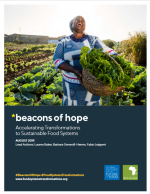 Beacons of hope : accelerating transformations to sustainable food systems
23 novembre 2021, par Mathilde COUDRAYThis report examines 21 initiatives that are working to achieve sustainable, equitable, and secure food systems.
-
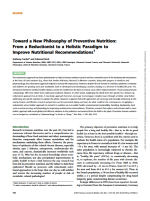 Toward a new philosophy of preventive nutrition : from a reductionist to a holistic paradigm to improve nutritional recommendations
27 octobre 2021, par Mathilde COUDRAYThe reductionist approach has been predominant to date in human nutrition research and has unraveled some of the fundamental mechanisms at the basis of food nutrients (e.g., those that involve deficiency diseases). In Western countries, along with progress in medicine and pharmacology, the reductionist approach helped to increase life expectancy. However, despite 40 y of research in nutrition, epidemics of obesity and diabetes are growing each year worldwide, both in developed and developing countries, leading to a decrease in healthy life years. Yet, interactions between nutrition-health relations cannot be modeled on the basis of a linear cause-effect relation between 1 food compound and 1 physiologic effect but rather from multicausal nonlinear relations. In other words, explaining the whole from the specific by a bottom-up reductionist approach has its limits. A top-down approach becomes necessary to investigate complex issues through a holistic view before addressing any specific question to explain the whole. However, it appears that both approaches are necessary and mutually reinforcing. In this review, Eastern and Western research perspectives are first presented, laying out bases for what could be the consequences of applying a reductionist versus holistic approach to research in nutrition vis-à-vis public health, environmental sustainability, breeding, biodiversity, food science and processing, and physiology for improving nutritional recommendations. Therefore, research that replaces reductionism with a more holistic approach will reveal global and efficient solutions to the problems encountered from the field to the plate. Preventive human nutrition can no longer be considered as “pharmacology” or foods as “drugs.”
-
 Biomasse. Une histoire de richesse et de puissance
26 octobre 2021, par Mathilde COUDRAYAu XVIIe siècle, Rubens, Vermeer, Rembrandt et bien d’autres utilisaient le bois de chêne de la Baltique, le lin ou le chanvre de Silésie, le pastel de Toulouse, l’indigo des Indes… Chaque œuvre était « une surface réduite où convergeaient des routes sillonnant le monde entier », nous dit Benoit Daviron, l’auteur de ce livre. La grandeur de la peinture hollandaise témoigne de la capacité du pays à s’approvisionner en produits de biomasse lointaine, cette matière composée ou issue du vivant. La quête de la biomasse d’un ailleurs lointain écrira l’histoire des trois siècles suivants. Avant que, au XIXe, l‘exploitation des énergies fossiles – la biomasse du passé – ne métamorphose les rapports à la biomasse immédiate. C’est une autre histoire, et une économie de l’agriculture plus vaste et plus globale, que Benoit Daviron nous propose. L’agriculture n’y est pas seulement alimentaire, ni la seule à fournir la biomasse. Comment, avant et après les énergies fossiles, les sociétés européennes ont-elles maîtrisé la distance et mobilisé le travail pour satisfaire leurs besoins croissants ? Quelles conséquences pour le reste du monde ? Au fil des périodes, nous découvrons que la capacité à mobiliser énergie et matière, et en particulier le vivant, est le miroir de la richesse et de la puissance du pays leader de son temps. Nous voyons se préciser les contours de l’agriculture dite naguère moderne, et aujourd’hui « conventionnelle » et le rôle central qu’a joué l’industrie chimique dans sa genèse. Cette lecture modifie nos interrogations sur l’avenir. Et, si le prochain leader est asiatique, quel rapport à la biomasse annonce-t-il ? S’appuyant sur une littérature abondante, Benoit Daviron nous présente une synthèse au-delà des frontières disciplinaires, dans laquelle se dessine une histoire longue, économique et politique, de la biomasse. S’il vise prioritairement enseignants, chercheurs et étudiants en agronomie et en économie agricole, ce livre intéressera les historiens et économistes, et aussi un public curieux des questions agricoles et alimentaires, de leurs enjeux passés et à venir.
-
 The place of food : mapping out the ‘local’ in local food systems
3 novembre 2021, par Mathilde COUDRAY‘Local food systems’ movements, practices, and writings pose increasingly visible structures of resistance and counter-pressure to conventional globalizing food systems. The place of food seems to be the quiet centre of the discourses emerging with these movements. The purpose of this paper is to identify issues of ‘place’, which are variously described as the ‘local’and ‘community’ in the local food systems literature, and to do so in conjunction with the geographic discussion focused on questions and meanings around these spatial concepts. I see raising the profile of questions, complexity and potential of these concepts as an important role and challenge for the scholar-advocate in the realm of local food systems, and for geographers sorting through them. Both literatures benefit from such a foray. The paper concludes, following a ‘cautiously normative’ tone, that there is strong argument for emplacing our food systems, while simultaneously calling for careful circumspection and greater clarity regarding how we delineate and understand the ‘local’. Being conscious of the constructed nature of the ‘local’, ‘community’ and ‘place’ means seeing the importance of local social, cultural and ecological particularity in our everyday worlds, while also recognizing that we are reflexively and dialectially tied to many and diverse locals around the world.