 Chaire UNESCO Alimentations du monde
Find here all project results in video
Accueil > Mots-clés > Dimension de l’alimentation > Holistique
Holistique
Articles
-
 All project results in video
22 March 2022, by Mathilde COUDRAY -
 Prendre ses distances avec le local ?
3 novembre 2021, par Mathilde COUDRAYOù l’on apprend que la relocalisation de notre alimentation permet notamment de restaurer des liens de confiance entre producteurs et consommateurs, souvent rompus par l’industrialisation et la globalisation des chaînes alimentaires. Mais où l’on réalise qu’il est tout à fait possible de reproduire localement des dysfonctionnements constatés à d’autres échelles ou de promouvoir un localisme étriqué. Et où l’on découvre l’idée d’un localisme cosmopolite…
-
 Pourquoi faudrait-il lutter contre le gaspillage alimentaire ?
17 décembre 2018, par Mathilde COUDRAYPourquoi un tel engouement depuis quelques années pour la lutte contre le gaspillage alimentaire ? Certes il y a une dimension morale à lutter contre le fait de jeter de la nourriture, un bien que l’on nous a appris à respecter depuis des temps anciens où il était rare. C’est justement parce que ce bien ne l’est plus qu’il a perdu de sa valeur et qu’on le gaspille. Mais pourquoi faudrait-il lui redonner de la valeur, rappeler qu’on doit le respecter et ne pas le gaspiller ?
-
 Food Systems Dashboard / Food Systems Types
26 octobre 2021, par Mathilde COUDRAYThe food system is all of the people and activities that play a part in growing, transporting, supplying, and, ultimately, eating food. These processes also involve elements that often go unseen, such as food preferences and resource investments.
Food systems influence diets by determining what kinds of foods are produced. They also influence what foods people want to eat and are able to access.
The different parts of the food system include food supply chains, food environments, individual factors, and consumer behavior, as well as external drivers (factors that push or pull at the system). These different parts shape food systems and can lead to both positive and negative outcomes.
-
 Towards a common food policy for the European Union : the policy reform and realignment that is required to build sustainable food systems in Europe
23 novembre 2021, par Mathilde COUDRAYThis report argues for a Common Food Policy for the European Union : a policy setting a direction of travel for the whole food system, bringing together the various sectoral policies that affect food production, processing, distribution, and consumption, and refocusing all actions on the transition to sustainability. The Common Food Policy vision draws on the collective intelligence of more than 400 farmers, food entrepreneurs, civil society activists, scientists and policymakers consulted through a three-year process of research and deliberation.
-
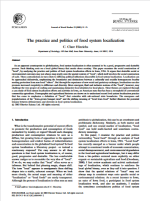 The practice and politics of food system localization
3 novembre 2021, par Mathilde COUDRAYAs an apparent counterpoint to globalization, food system localization is often assumed to be a good, progressive and desirable process. Such thinking rests on a local–global binary that merits closer scrutiny. This paper examines the social construction of “local”, by analyzing the practice and politics of food system localization efforts in Iowa, USA. It argues that desirable social or environmental outcomes may not always map neatly onto the spatial content of “local”, which itself involves the social construction of scale. These contradictions in turn relate to differing political inflections discernible in food system localization. Localization can be approached defensively, emphasizing the boundaries and distinctions between a culturally and socially homogeneous locality needing protection from non-local “others”. But through the experience of new social and gustatory exchanges, localization can also promote increased receptivity to difference and diversity. More emergent, fluid and inclusive notions of the “local”, however, may challenge the very project of crafting and maintaining distinctive food identities for local places. These themes are explored through a case study of food system localization efforts and activities in Iowa, an American state that has been a stronghold of conventional commodity agriculture. Demographic and agricultural histories are drawn on to understand recent food system localization practice that has come to emphasize a definition of “local” that coincides with sub-national state boundaries. The emergence and popularization of the “Iowa-grown banquet meal” and the shifting meaning of “local Iowa food” further illustrate the potential tension between defensiveness and diversity in food system localization.
-
 What’s on the menu ? A global assessment of MUFPP signatory cities’ food strategies. Agroecology and Sustainable Food Systems
23 novembre 2021, par Mathilde COUDRAYIncreased recognition of the persistent and interconnected nature of food system challenges resulted in the creation of the Milan Urban Food Policy Pact (MUFPP) in 2015. MUFPP signatory cities commit themselves to contribute to a better functioning food system by adopting integrated approaches. This study assesses the number of MUFPP cities that have developed food strategies and the choices local policymakers make in the design of these strategies. The results show surprising similarities between cities across regions in terms of goals and instruments. At the same time, local governments clearly put different emphases and seem to vary in policy styles.
-
 Introduction - Carole Sinfort et Philippe Petithuguenin
21 juin 2022, par Mathilde COUDRAY -
 An emerging user-led participatory methodology : Mapping impact pathways of urban food system sustainability innovations
23 novembre 2021, par Mathilde COUDRAYThis chapter presents the general framework for the URBAL project as well as the main interwoven considerations and approaches that are the backbone of the methodology. Please note that this is an ongoing project and that it has evolved since the chapter has been written. We will point out some changes in the methodology as the chapter proceeds
-
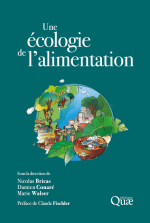 Pourquoi une approche écologique de l’alimentation ?
3 novembre 2021, par Mathilde COUDRAYOù l’on remonte aux origines de l’écologie, comme discipline scientifique puis comme mouvement politique, et où sont exposés deux arguments justifiant l’adoption de l’écologie comme grille de lecture pour penser l’alimentation au regard de ses enjeux de durabilité : en tant que « science carrefour » de l’étude des relations et pour sa dimension politique.